CMWU participated in a Journalists Syndicate conference on the crises of water scarcity and waste accumulation in Gaza, presenting the scale of destruction and urgent needs facing the sector.
CMWU participated in a conference organized by the Palestinian Journalists Syndicate, held at its temporary headquarters west of Al-Qarara, southern Gaza Strip, titled Intersecting Crises: Interventions Addressing Water Scarcity and Waste Accumulation in the Gaza Strip, attended by CMWU Deputy Executive Director Eng. Omar Shatat, Deputy Head of the Palestinian Journalists Syndicate Dr. Tahseen Al-Astal, and Mr. Raafat Al-Qidra, Director of Radio and Television in the Southern Governorates, alongside representatives of a number of relevant institutions.
During his remarks, CMWU Deputy Executive Director Eng. Omar Shatat explained that the water sector faced extremely difficult conditions at the start of the war, represented by the cutoff of electricity and Mekorot water supplies, the closure of crossings, fuel depletion, and intense waves of displacement, which created significant pressure and a growing burden on water facilities and essential services.
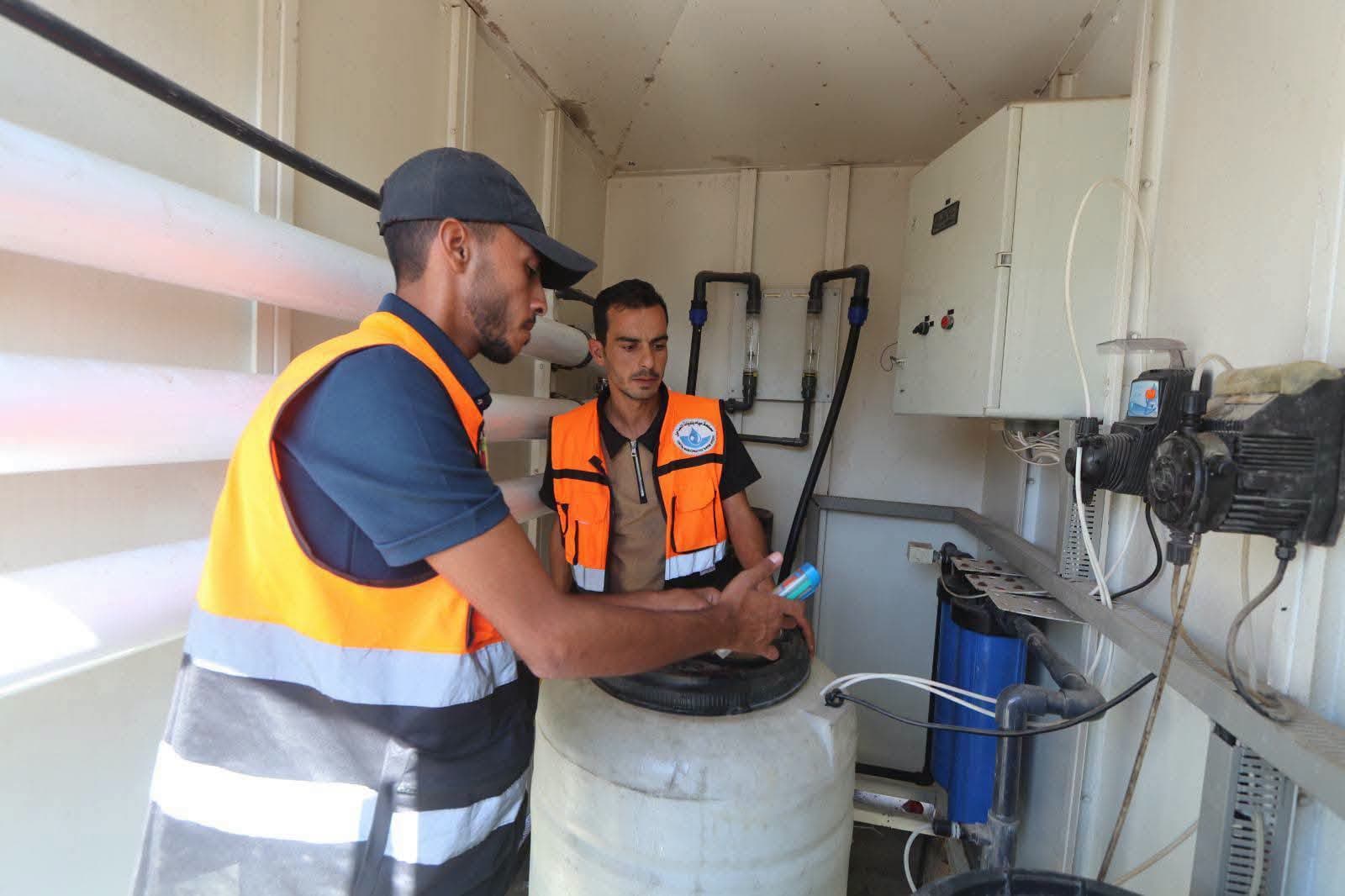
He also explained that CMWU's role was to urgently supply residents and displaced persons with drinking water through its tankers, and to work on operating desalination plants in the central and southern Gaza Strip, in addition to carrying out emergency maintenance works on water and sanitation facilities, despite the difficulty of working under extremely complex security conditions that threatened the lives and safety of workers, who were targeted several times while carrying out their duties.
He noted that CMWU, in partnership with its local and international partners, continued working despite the enormous challenges to maintain the minimum continuity of water and sanitation services, and to provide an emergency response according to available capacities, pointing to the scale of the significant destruction sustained by the water and sanitation sector, including the destruction of desalination plants, sewage treatment plants, pumping stations, water wells, and rainwater drainage systems, in addition to the challenges related to the acute shortage of spare parts, fluctuating fuel quantities, and the deterioration of generators and heavy machinery, affirming the difficulty of determining the actual scale of the damage sustained by the water and sanitation sector given the extensive destruction left by the Israeli war machine.