An extensive interview with Director-General Monther Shoblaq on the challenges of operating the three desalination plants and five treatment plants in Gaza, and the electricity crisis and operational funding.
The Challenges of Operating Water Desalination Plants in the Gaza Strip.
CMWU's Director-General Eng. Monther Shoblaq revealed details of the water situation in the Gaza Strip, the challenges facing the water sector, and the most prominent achievements and projects.
Shoblaq said in a special interview with Sawa News Agency that since 2011 until 2019, we were able, in cooperation with the Palestinian Water Authority and with support from some donor institutions, to implement a set of short- and medium-term solutions and began the stages of preparing sustainable solutions, despite two wars and numerous rounds of escalation passing during this period.
He explained that everything the occupation destroyed during the last two wars and rounds of escalation was rebuilt in record time, at a cost of about $35 million for the last war in the summer of 2014, and about $5 million for the damage of the 2012 war, from donor institutions' funds.
Shoblaq affirmed that Palestinians have the capability and competence to devise solutions, noting that donor institutions participate in finding solutions and have begun to think seriously about distinguishing between the complications of the political situation and the need of Gaza's residents for basic services.
The Rolling Water Program
In a related context, Shoblaq revealed a program developed by the Palestinian Water Authority and implemented by his Utility, funded by numerous donor institutions in cooperation with the Water Authority, called the "Rolling Water Program," which consists of short-term and long-term strategic solutions.
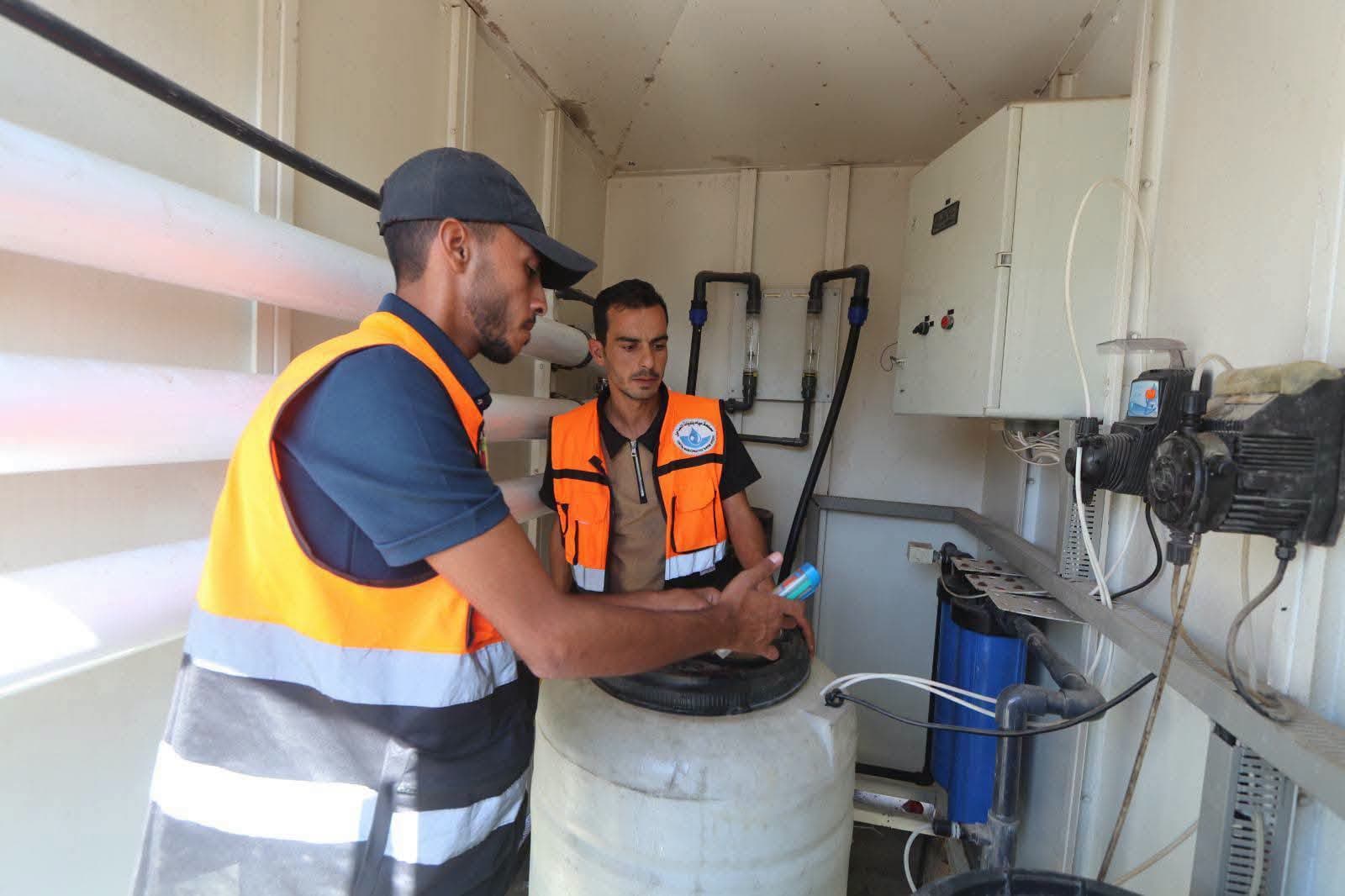
Regarding the short-term solutions, according to Shoblaq, they consisted of three small-sized seawater desalination plants, the first north of the Gaza Strip, the second in the Central Governorate, and the third south of Deir al-Balah, in addition to three sewage treatment plants, two of which have been completed and the third is nearing completion.
Desalination Plants
Regarding the desalination plants, Shoblaq explained that the northern plant began trial operation since this past August, and is supposed to produce 10,000 cubic meters for Gaza city, as the largest population center and the political and economic capital of the Strip.
He noted that some residents in the western area of Gaza city have recently begun to feel a positive change in the quality of the water that used to reach them extremely salty.
According to Shoblaq, CMWU will take over and operate this plant from the contractor after its trial period ends, in order to serve about 250,000 residents in Al-Shati, Sheikh Radwan, Western Al-Nasr, and Southern Al-Remal areas, in coordination with Gaza Municipality.
He noted the existence of a financial problem related to appointing the operating team needed for the northern plant, explaining that his Utility asked the Water Authority to secure financial support or an operating budget to appoint and train a new team, as happened at the southern plant.
He said: "If we operate it today and Gaza Municipality, as a beneficiary, commits to paying the desalinated water bill it distributes to residents and collects its price, we will be able to secure the operating budget for the plant, including the operating team."
He added: "Unfortunately, we are all managing a crisis in Gaza," explaining that CMWU might be forced to operate the northern plant for two or three hours daily with a team from the main headquarters, until an operating budget becomes available to appoint an operating team for the plant.
As for the desalination plant in Deir al-Balah, it currently produces, according to Shoblaq, 6,000 cubic meters, noting that it is blended with water from some wells to double the quantity and reduce the cost.
He explained that this plant will serve residents of Deir al-Balah and Al-Zawayda areas, and is expected to reach other areas in the Central Governorate if we are able to operate it around the clock.
Regarding the third plant south of Deir al-Balah, funded by the European Union, its first phase was opened more than a year ago in the presence of then-Prime Minister Dr. Rami Hamdallah and Water Authority Chairman Eng. Mazen Ghanem.
He explained that in the first phase of this plant, 6,000 cubic meters were put into operation, with water reaching Al-Amal neighborhood area west of Khan Younis and Tal Al-Sultan in Rafah, noting that a contractor was contracted to complete the second and third phases together, so that production reaches 20,000 cubic meters, funded by the European Union through UNICEF in partnership with the Palestinian Water Authority.
The southern Deir al-Balah plant is supposed to cover the center and south of the Strip, up to Rafah area and the eastern towns, once its production reaches 20,000 cubic meters after completing the second and third phases, as Shoblaq said.
In the end, when what the plants produce (20,000, 6,000, 10,000 cubic meters) is combined, 70 to 72 thousand cubic meters will be available, which would cover the needs of about half the population of the Gaza Strip most affected by the deterioration of drinking water quality, as total consumption currently amounts to about 160,000 cubic meters.
He noted the existence of other water sources for the rest of the Strip's residents, particularly Israeli Mekorot water, explaining that the total amount currently reaching the Gaza Strip from the Israeli side is about 10 million cubic meters, covering the eastern areas of Khan Younis, the Central Governorate, and Gaza city, which receives about 5 million cubic meters via the "Nahal Oz" area, transported from Al-Muntar reservoir to the east and center of Gaza city.
He noted that some areas in the Gaza Strip do not suffer from water salinity, adding: "But we will have water available from three sources: desalination, Israeli Mekorot, and some wells spread across the Strip with reasonable quality," noting in the same context that "once these sources are complete, we may, by 2020, have passed the danger stage."
In this regard, he noted the existence of an agreement not yet implemented with Israeli "Mekorot," whereby the quantity of water coming from it to the Strip would be increased from 10 to 20 million cubic meters annually.
He stressed that the strategic solution to the water quality problem in the Gaza Strip lies in beginning and completing the central desalination plant, explaining that according to what Water Authority Chairman Eng. Mazen Ghanem announced, about 80% of the funding needed to construct the central desalination plant has been secured.
He said: "The current desalination plants, Mekorot water, and this whole program can help us cover residents' water supply needs according to Palestinian water quality standards until 2025."
Treatment Plants
In another file, Shoblaq reviewed the reality of the work of the five sewage treatment plants in the Gaza Strip, namely (Beit Lahia plant in the north, Sheikh Ajleen, Wadi Gaza, west Khan Younis, Tal Al-Sultan).
He said that Beit Lahia station has almost been closed, since the north's sewage now goes towards the new "NGEST" plant, adding that Sheikh Ajleen station in Gaza city was developed by CMWU in cooperation with Gaza Municipality, funded by the German government through KfW, and can operate with high efficiency until 2025.
Shoblaq revealed that 50% of the sewage water at Sheikh Ajleen will be diverted by the end of 2019 towards the new plant east of Al-Bureij.
Regarding Wadi Gaza station, it is, according to Shoblaq, temporary and has become unable to operate with the efficiency it was constructed for, but it is supposed to be closed once Al-Bureij plant begins operation by the end of this year.
He mentioned that the west Khan Younis station is a "temporary transitional" one, explaining that "it will be closed as soon as the new plant east of Sofa begins operation before the end of 2019," funded by the Japanese government and the Islamic Development Bank through UNDP and in partnership with the Water Authority.
Shoblaq continued that Tal Al-Sultan station has been developed twice, in order to be able to serve Rafah governorate until 2025, noting that it will be merged in the future with Khan Younis station, where a station was constructed there and will soon be tested and expanded in the future to accommodate Rafah's sewage, but that requires securing a plot of land near it and the funding needed for that.
He affirmed that all sewage treatment plants in the western areas are supposed to be closed in the future, between 2025 and 2030, so that all the Strip's sewage is in the eastern areas.
He explained that three strategic plants will be in the eastern areas of the center, north, and south of the Strip, to accommodate sewage water, treat it, reuse it in agriculture, and inject it into the groundwater aquifer.
According to Shoblaq, the plants are being developed to operate around the clock, but the electricity crisis makes them currently operate only 8 hours "for example."
In this regard, he expressed his pride in what has been achieved regarding Al-Bureij plant, explaining that an agreement was reached with the KfW institution, representing the donor body, on the importance of securing funding for the treatment plant's operating expenses for a period of 3 to 5 years, including appointing the operating team.
He said he is working with the Ministry of Local Government and the Central Governorate and Gaza municipalities to sign an agreement together with the latter's contribution at increasing rates, noting that the donor body set a condition of granting 5 years but decreasing as the municipalities' contribution increases.
Regarding the southern plant, he hinted at the existence of negotiations with the Islamic Development Bank (the donor body), led by UNDP and the Water Authority, to secure the remaining investment expenses for the completed project, and convert them into operating expenses until the economic situation improves.
Electricity, the Biggest Challenge
Regarding the challenges facing CMWU's work, he explained that the chronic problem is electrical power, asking about the Electricity Company's ability to supply the water sector with its needs for a period exceeding 16 hours amid the electricity crisis that is no secret to anyone.
He noted that CMWU is trying to find an alternative to conventional electrical power by constructing solar power units, explaining that this alternative needs wide spaces in addition to its high cost.
According to Shoblaq, the desalination plant in the Central Governorate is ready and produces 6,000 cubic meters daily, but permanent electricity has not yet reached it to operate it, while the southern plant needs 3 megawatts but has not received more than 8 hours of electricity daily within the regular electricity schedule.
He mentioned that solar power was installed for the southern desalination plant, but it only provides half a megawatt out of the three required, affirming the readiness of the three desalination plants to operate, but the electricity problem does not allow them to operate at full efficiency.
He also addressed another challenge, which is the financial capacity to continue operating the desalination and sewage plants, explaining that the plants need to cover the cost of the operating team, spare parts, the electricity bill, and chemicals.
He said: "If the resident does not pay their bill due to the current economic situation, another supporting party is supposed to exist, so we have knocked on the doors of national institutions and donor institutions in this regard," noting the low collection rate in the Gaza Strip, which in some areas has reached less than 20%.
He added: "Desalination and treatment are both costly," noting that the cost of operating the current water and sanitation facilities has reached about $40 million annually, and is expected, with the new strategic facilities coming into service one after another, to jump to $80 million during the coming five years.
In this regard, Eng. Shoblaq expressed his fear "that we will have achieved a national achievement and found solutions to the water and sanitation problem, then it stops if we are unable to pay the operating bill," warning that the plants are consequently threatened with stopping at any moment.
News link: https://palsawa.com/post/221938/تحديات-تشغيل-محطات-تحلية-المياه-في-قطاع-غزة