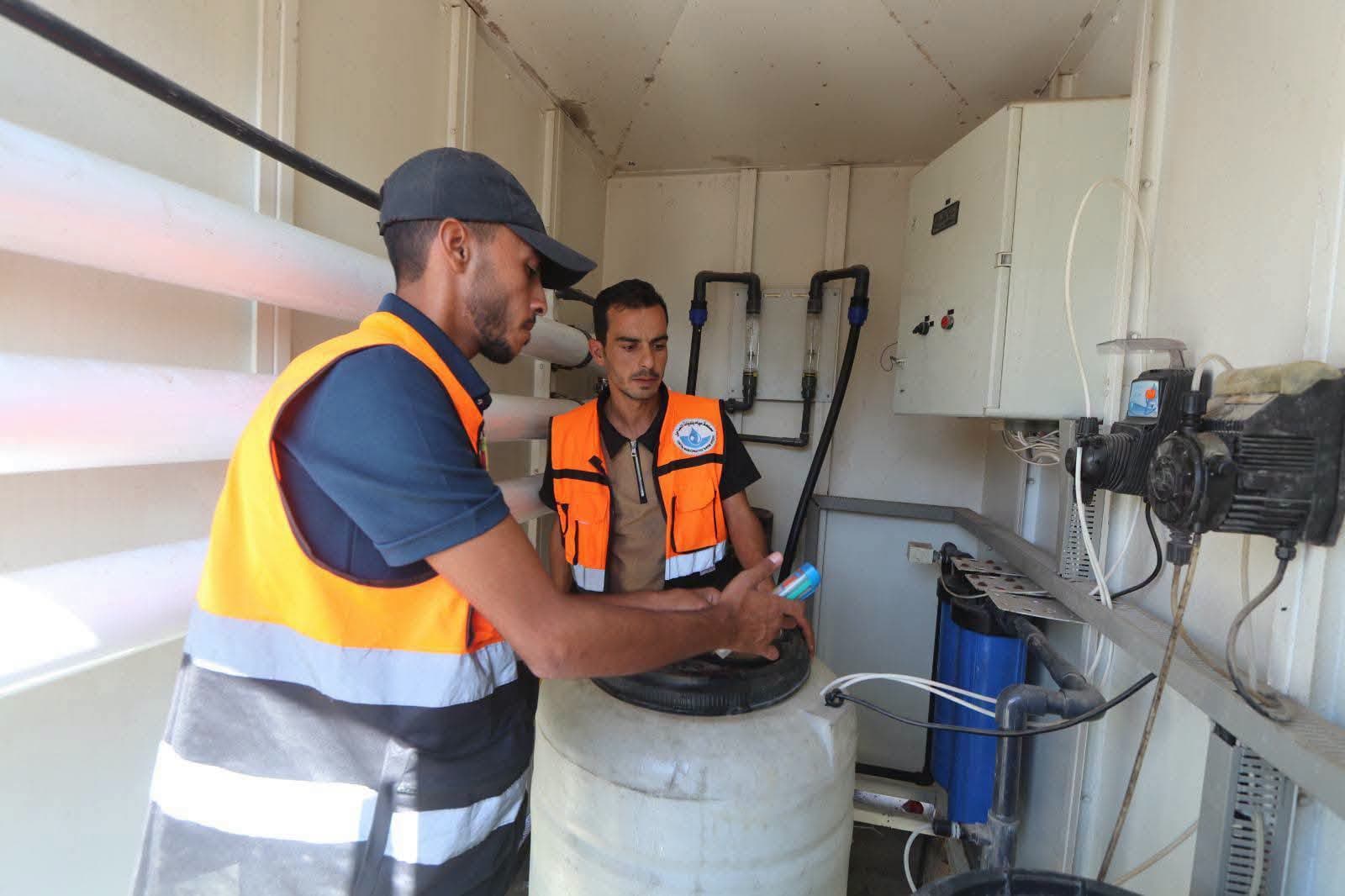
Beginning the construction of a solar power plant with a capacity of up to 7 megawatts for the sewage treatment plant in Khan Younis, funded by Norway, the EU, and the Islamic Development Bank, to ensure its continuous operation.
To Ensure the Continuous Operation of the Sewage Treatment Plant
Beginning the Construction of a Solar Power Plant at the Sewage Treatment Plant in Khan Younis
Gaza – CMWU
CMWU, Khan Younis Municipality, and UNDP began constructing a "solar power plant" to supply the sewage treatment plant located east of Al-Fukhari town with alternative electricity.
Khan Younis Municipality's Mayor and member of CMWU's Board of Directors Dr. Alaa Al-Din Al-Batta affirmed the importance of the project, which will end the problem of repeated power outages at the Central Treatment Plant, which causes numerous malfunctions as a result of its sudden shutdown due to power outages, as well as reducing the plant's operating costs, noting that the cost of electricity represents about 65% of the total cost of operating the treatment plant.
The Central Treatment Plant east of Khan Younis receives (16,000) cubic meters daily of sewage water, with a capacity of (26,000) cubic meters daily in the first phase, and it will be developed to accommodate 45,000 cubic meters daily, sufficient to cover all of Khan Younis governorate, as the plant will serve more than (340) thousand people.
CMWU's Director-General Eng. Monther Shoblaq stated that this project will be implemented in three phases, with Phase One including extending a line with a capacity of (1.3) megawatts funded by Norway through UNDP in cooperation with CMWU, and CMWU will implement Phase Two to extend a line with a capacity of (2.2) megawatts in cooperation with Khan Younis Municipality and funded by the European Union, as well as Phase Three with a capacity of (3.5) megawatts funded by the Islamic Development Bank, thereby completing the project's total capacity to reach about (7) megawatts.
It is worth noting that the amount of energy that will be produced by the solar power plant will be sufficient to cover the plant's loads for Phases One and Two, as it will use half the project's capacity directly during the day and the remaining half will be supplied to the electricity company, to benefit from it in increasing the amount of electricity supplied to residents during the day, with the electricity company compensating the plant for it at night, and Phase One is expected to be completed within eight months according to the project's timeline.